


2025 Honorary President: Germain Lamonde
“Your company, like all economic sectors, has in common the need to communicate, coordinate and improve its productivity – all in a safe and efficient way.
It doesn’t matter if your information tools are simple or advanced; whether your infrastructures are residential, web or cloud-based; participating in the JIQ day is an excellent way to anticipate the future in order to gain a significant competitive advantage.”
-Germain Lamonde, Founder and CEO of EXFO
AGENDA
Click on the image, then double-click to zoom in.

CONFERENCES - 50 minutes
8H15 - SALLE E
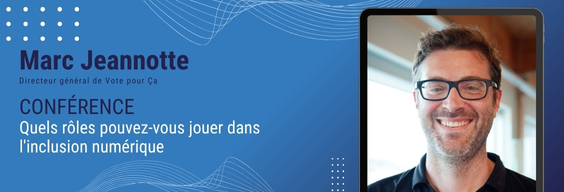
The digital divide refers to social inequalities caused by difficulties in access, limited use of digital technologies, and/or underrepresentation in digital data. Digital transformation is widening these gaps.
The conclusion is clear: actions to address or reduce it are not progressing fast enough. Who is being left behind? How can we identify them? Who can we collaborate with to make greater progress?
This conference aims to deepen our understanding of the digital divide and to collectively equip ourselves to foster greater digital inclusion.
Marc Jeannotte co-founded Votepour.ca in 2014. After about fifteen years of experience in communications and public affairs — at Bell Canada, in elected officials’ offices, and at the Association francophone pour le savoir (ACFAS) — social entrepreneurship became part of his professional journey. Holding a bachelor’s degree in political science, he went on to pursue further studies in participatory design and municipal law to deepen his understanding of social acceptability and public participation.
For six years, Marc served on the board of directors of the Groupe Femmes, Politique et Démocratie (GFPD). He is a member of the International Association for Public Participation and has sat on the Government of Quebec’s Open Government Committee for the past two years. Over the past year, he has been a speaker at events organized by the Association des communicateurs municipaux du Québec, the Fédération québécoise des municipalités, ACFAS, and Les Entretiens Jacques Cartier.
10H00 - SALLE 5
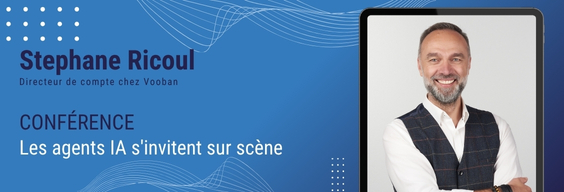
We’re all dazzled by this famous generative AI — the one that produces brilliant texts and stunning videos.
But while we’re focused on it, the real value is being built behind the scenes — where data, business rules, operational research, and the processes that keep our organizations running all come together.
And now, new players are taking the stage: AI agents. Deployed solo or in groups, these are autonomous agents that organize themselves, collaborate, and deliver tangible results—sometimes without a human lifting a finger.
Join us as we take stock of where we are, where we’re headed… and the paths we might be better off avoiding.
At the crossroads of business and digital innovation, Stéphane Ricoul seeks to understand how organizations can harness the power of digital technology—and especially AI—without losing their human, regulatory, and economic compass.
After more than 30 years in technology services, he now supports client company managers at Vooban, Canada’s leading artificial intelligence firm, turning promises into measurable results. A regular contributor to the podcast Mon Carnet with Bruno Guglielminetti and on LCN with Pierre-Olivier Zappa, he demystifies the concrete challenges of AI for the economy and society every week. Author of the book Vos clics. Leur cash., he advocates for models suited to the digital age.

10H00 - SALLE 6-7
As key players in the development of sovereign, ethical, and responsible artificial intelligence, Canadian universities are shaping the future of research. Among Canada’s leading research universities, Université Laval stands out for its comprehensive AI ecosystem, spanning computing power, data from all fields of knowledge, and the expertise of its scientific community. This ecosystem transforms research into tangible outcomes and fosters collaborations with stakeholders from all sectors of society.
Come explore Université Laval’s comprehensive AI research ecosystem and experience an immersive virtual reality tour inside tamIA, the country’s first AI research computing cluster, hosted on our campus in an energy-efficient environment that recovers its heat to help warm our buildings.
Patrick Marois is the Director of the Digital Research Office at Université Laval. Reporting to the Vice-Rectorate for Research, Creation, and Innovation, he leads a team that guides, promotes, and supports initiatives aimed at increasing and strengthening the use of digital technologies in research projects and the administrative activities that support them. He is also responsible for the AI roadmap for the research sector as part of the university’s institutional initiatives on responsible AI.
With over 25 years of experience in digital technology—ranging from software development to cybersecurity, as well as teaching, analysis, and business architecture—he brings an integrated vision of digital innovation that combines organizational benefits, digital transformation, and institutional strategy. He also earned a PhD in Information Systems from the Faculty of Business Administration at Université Laval (FSA ULaval), where his research focuses on free and open-source software (FLOSS), particularly the communities that develop and support it.
10H00 - SALLE 8-9
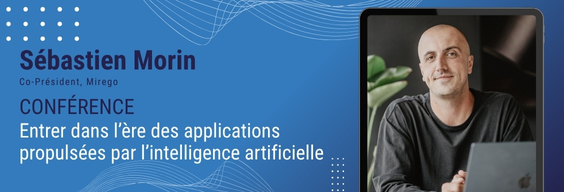
Every week, literally tens of thousands of new AI models are made available to the public, thereby democratizing access to the technology for organizations and their development teams. We are on the cusp of an era in which millions of new products, features, and tools will be built on the shoulders of these numerous models.
This conference explains the phenomenon, attempts to predict the next steps, and shows how organizations can accelerate the deployment of artificial intelligence within their operations and build their own intelligent tools to turn technology into a strategic lever.
Sébastien has been working in the digital world for over 20 years. He has helped build innovative digital products that have profoundly transformed organizations and are part of the daily lives of millions of users.
As Co-President of Mirego, he is responsible for everything related to the service offering and client satisfaction. He is also tasked with building the best team and the most effective processes for creating digital products.

10H00 - SALLE 10
Coming
Erick Brethenoux is Chief of Research in Artificial Intelligence (AI) at Gartner. Through his research and consulting activities, he guides organizations in the strategic, technological and pragmatic implementation of AI techniques, as well as next-generation decision modeling systems.
Prior to joining Gartner, he was Director of Machine Learning and Analytics Strategy at IBM. Previously, he held the position of Vice President of Corporate Development at SPSS, a pioneer in predictive analytics, and previously as Vice President at Lazard Frères.
Prior to his time at Lazard, Erick led a scientific mission for the Embassy of France in the United States, while continuing his research as a PhD student at the University of Delaware as part of a multidisciplinary program in cognitive science. Erick is currently an Assistant Professor at the Illinois Institute of Technology in Chicago.
11H10 - SALLE 5
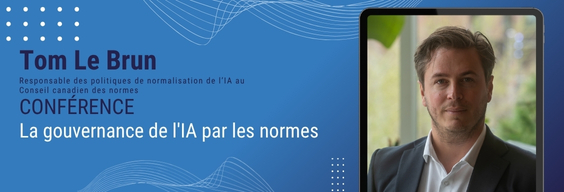
Governing artificial intelligence (AI) can seem complex. However, a robust governance framework already exists through international and national standards (ISO/IEC, CEN-CENELEC, CSA, etc.), making it possible to operationalize this governance in a concrete, rigorous and measurable way. Adopting a standards-based approach ensures that you understand what you are implementing, generate a real return on investment, and effectively manage the risks associated with this technological transformation.
Tom Lebrun works at the forefront of governance, regulation, and international standardization of artificial intelligence. As the lead for AI standardization policies at the Canadian Standards Council, he shapes national and international strategies by collaborating with governments, industry, and global organizations.
With over ten years of experience in AI, data, and privacy policy, he also teaches AI law at Laval University and serves as a consultant to industry for Confiance IA. He holds a PhD (summa cum laude) on AI-generated texts, as well as an LL.B. and an LL.M. in digital law from the Sorbonne.

11H10 - SALLE 6-7
Coming
Darine Ameyed, Ph.D. (Dr. Ing.) She is a leader in AI and Innovation, driven by the desire to turn emerging technologies into tangible and measurable impacts. She currently serves as Head of AI & Innovation | Engineering Manager at Aduna Canada (formerly GNP-Ericsson), where she leads multidisciplinary R&D teams and drives AI adoption initiatives within the company.
Since 2005, her career has unfolded at the intersection of industry, the public sector, and academia, across Canada, Europe, and Africa. She has led technological and scientific programs related to information systems, artificial intelligence, and cognitive digital platforms.
Before joining Aduna/Ericsson, Dr. Ameyed played a key role in AI adoption within the public sector. She notably served as Head of AI & Automation at the Quebec Ministry of Transport and Sustainable Mobility (MTMD), as well as Head of the AI Unit at the Ministry of Cybersecurity and Digital Affairs, where she led the provincial AI strategy, launched a laboratory dedicated to automation and AI, and supported the deployment of government-wide AI projects. She also co-founded and held the roles of Chief Scientific Officer / CTO in several tech startups, where she guided R&D and product strategies.
She holds a PhD in Engineering, specializing in Artificial Intelligence and Ubiquitous Systems, from the École de technologie supérieure (ÉTS), as well as a certificate in Applied AI from Columbia University (New York). Her academic background also includes a Master’s in Arts and Technology, a Master’s in Multimedia Engineering and Human–Computer Interaction from Université Paris-Sud (Paris 11), and a Bachelor’s degree in Computer Science and Management.
Dr. Ameyed is also an Associate Professor at the Université du Québec à Chicoutimi, where her research focuses on large-scale applied AI, safety and trust in AI systems, intelligent cyber-physical systems, and contextual learning. She also serves as an expert for the International Telecommunication Union (ITU) and contributes to the United Nations initiative ‘United for Smart and Sustainable Cities.
Recognized for her ability to combine strategic vision with practical implementation, she designs and deploys technology action plans aimed at enhancing competitiveness, efficiency, and quality, thereby helping organizations fully leverage AI in a responsible, secure, and large-scale manner.

11H10 - SALLE 10
Go behind the scenes of the international “Cookie Monster” operation, in which the Sûreté du Québec, the CNC3 and several police services in Quebec, Canada and around the world participated.
This conference will highlight the critical importance of collaboration between international and domestic law enforcement, as well as the strategic implications of this operation on the trust of malicious actors in their own criminal infrastructures. A unique opportunity to understand how cooperation and innovation are redefining the fight against cybercrime.
Sergeant Piché is a team leader with the Cybercrime Investigation Service (SECyb) of the Sûreté du Québec. This team is responsible for investigating major criminal events targeting computer infrastructures for all of Quebec, while providing support to Quebec police investigators in connection with their investigations involving information technology.
Recently, the SECyb participated in Operation Cookie Monster coordinated by the FBI, conducting searches of seven suspects and coordinating with other Quebec police forces meetings targeting persons of interest who had used the Genesis Market platform.

13H40 - SALLE E
Coming
Germain Lamonde holds a Master’s degree in Physics from Université Laval, a Bachelor’s degree in Engineering Physics from Polytechnique Montréal and an Executive MBA from Western IVEY University in Ontario.
In 1985, while he was both an engineer and a full-time master’s student, Mr. Lamonde launched EXFO with the goal of becoming the world’s leading player in the telecommunications industry’s fiber optic testing market. Today, the company has 1800 employees in 25 countries and has been able to pay more than $2 billion in salaries in Quebec. EXFO serves more than 2,000 customers in more than 125 countries, including 95 of the top 100 telecom operators.
Committed to his community, Mr. Lamonde is Vice-President of the Board of Directors of the Conseil de l’innovation du Québec, sits on the board of the QG100 network, the Advisory Committee on Research & Innovation created by the Chief Scientist of Quebec, in addition to having been an entrepreneur-coach at the École d’Entrepreneurship de Beauce.
Visionary, ambitious and results-oriented, Germain Lamonde has been honoured several times during his career. He was named a Grand Québécois by the Chambre de commerce et d’industrie de Québec in 2020 and Canada’s Entrepreneur of the Year, Ernst & Young, in 2018.
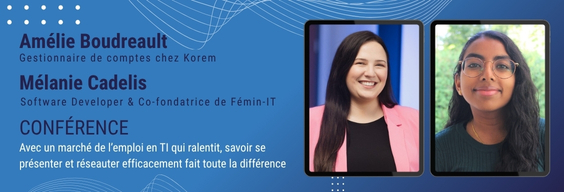
14H20 - SALLE 6-7
In this session, discover practical tools to present yourself with impact and expand your circle of influence. Whether it’s introducing yourself, showcasing your work results, or simply making your voice heard, these tools help you stand out.
Amélie Boudreault is an Account Manager at Korem, where she leverages her technology expertise as a former Full Stack developer. She is the co-founder of the non-profit Fémin-IT and has been a Google Women Techmakers ambassador since 2020, showing strong commitment to the Quebec tech community, especially for emerging talent. A graduate of Laval University in Software Engineering, she has distinguished herself in various leadership roles, promoting inclusion, innovation, and collaboration in the IT sector.

15H00 - SALLE 5
At a time when data lies at the heart of our economy and security, “digital sovereignty” has become a major strategic issue on the global stage. Yet, this concept is too often oversimplified and reduced to a single question: the physical location of our data centers.
But in a hyper-connected world, defined by global cloud services (hyperscalers) and cross-border data flows, is this definition still sufficient? Does true sovereignty not lie as much in the control of our infrastructures as in the resilience of our encryption?
This panel discussion brings together two experts in Cloud computing and cryptology for a balanced exchange on the future of our strategic autonomy. We will examine the real possibilities and the limitations of current Cloud systems in safeguarding our operational sovereignty.
Far from partisan rhetoric, this discussion aims to redefine what it means to be sovereign in 2025. Is it a matter of infrastructure, legislation, or cryptographic innovation? Join us as we explore realistic paths toward digital sovereignty suited to our times.
Mr. Couillard has over 35 years of experience in cybersecurity, with recognized expertise in cryptography and key management. A former telecommunications officer in the Canadian Forces and a member of the Communications Security Establishment (CSE), he co-founded Chrysalis-ITS, where he led the development of the Luna HSM product. Today, as CEO and co-founder of Crypto4A, he drives the creation of fifth-generation HSMs — the QxEDGE/QxHSM — designed to be crypto-agile and quantum-threat ready. Passionate about innovation, he actively works to accelerate the transition to the quantum era and strengthen cryptographic agility in Canada and internationally.
Cédric Thibault, holder of an MSc in Information Security, is a recognized expert in cybersecurity and cloud security, with multiple certifications, including CISSP, CCSK, AWS (6x), HashiCorp, and GCSA. As a cybersecurity associate at KPMG Canada, he plays a key role in developing and optimizing the firm’s Cloud security offerings.
Passionate about cloud security, Cédric leads a dynamic team dedicated to supporting a wide range of clients, both in Canada and internationally, on their “Journey to the Cloud.” His expertise spans all aspects of this transition, including migration readiness, security posture assessment, implementation of robust security controls, and continuous process improvement.
With over 30 years of experience in information technology, Cédric has worked in various military and civilian organizations, both in France and Canada. His diverse background allows him to bring a unique perspective and tailored solutions to the complex challenges of modern cybersecurity.
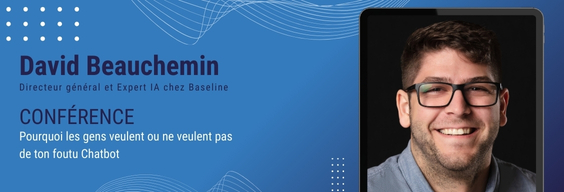
15H00 - SALLE 8-9
Chatbots are often touted as the silver bullet to revolutionize customer service, but the reality is more nuanced.
Based on an experience study with 154 consumers who interacted with a convict insurance chatbot, this conference delves into the deep motivations and frustrations of users. We will explore the reasons that push people to adopt these tools, but also the obstacles that lead them to want to return to a human agent.
The goal is to provide a practical guide on how to design an AI project that actually meets the needs of users, not just technical or organizational goals.
David Beauchemin holds a bachelor’s degree in actuarial science and a master’s degree in computer science specializing in machine learning. His research work, focused on the extraction and valorization of data in the insurance sector, led him to a doctorate on the automatic explanation of insurance contracts. He has more than 10 years of experience in AI solution development, product development and developing expertise at the frontier between technical knowledge and business strategy.
Co-founder and CEO of Baseline, he launched the cooperative with five academic colleagues to make artificial intelligence more accessible for SMEs. At the same time, he co-founded Meetup Machine Learning Quebec, to encourage knowledge sharing, as well as . Layer, a non-profit organization that he chairs and which aims to promote data science.
A finalist for CEO of the Year – CEO Vision, David is recognized for his committed leadership. He is a regular speaker at conferences, training courses and podcasts such as the SaaSpasse podcast, where he passionately popularizes AI. He has presented on issues such as governance, generative AI, natural language processing and model reproducibility.
Its vision: to make AI a lever for sustainable transformation, rooted in human realities, at the service of collective and equitable progress, by offering a consulting service adapted to the challenges and ambitions of each organization.
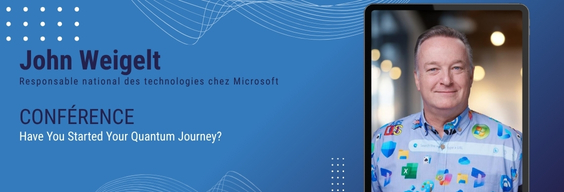
15H00 - SALLE 10
Quantum computing is advancing rapidly with ever increasing capabilities announced on a regular basis. With every advancement comes new opportunity but also renewed concern about the threats that these computers may introduce. While experts have speculated for years about when meaningful quantum computers may become available, a consensus has emerged that now is the time to get ready for them.
Join John Weigelt, Chief Technology Officer for Microsoft Canada, as he helps demystify these powerful new computers, sets the foundation for today’s Quantum reality, describes the opportunities for Canada, examines what organizations should start doing today and explores areas of future exploration.
John Weigelt leads Microsoft Canada’s strategic policy and technology efforts. He helps individuals and organizations across Canada innovate with technology while avoiding the unintended consequences that might arise.
John has contributed to many technological efforts that established the foundation for the electronic services we take for granted today and he continues to lead efforts to evolve technology standards and policy. His extensive experience in technology, business and policy provides him with a unique perspective of our technology enabled economy.
When he’s not thinking about what’s next in technology, you’ll either find John tending his bees, boiling maple syrup or brewing cider at his home or travelling the globe in search of his next culinary adventure.

15H15 - SALLE 6-7
Le Réseau Action TI, en collaboration avec l’Office québécois de la langue française, vous invite à un panel inspirant sur les avantages d’entreprendre et de communiquer en français au Québec.
Thématiques abordées :
• Le français comme levier économique et facteur d’attractivité dans un marché concurrentiel;
• Le rôle du français dans l’intégration et la rétention des talents;
• Les stratégies d’adaptation linguistique mises en place dans les organisations;
Jean-François est fondateur de Pour l’amour du français et détient deux maîtrises en gestion de HEC Montréal. Il s’intéresse aux enjeux de gestion liés aux langues et développe des solutions innovantes pour valoriser le français en organisation. Il est membre fondateur du comité du français de HEC Montréal et a contribué à la création de son plan stratégique de valorisation du français.
Trilingue, il s’intéresse à l’insécurité linguistique, notamment chez les anglophones qui apprennent le français. Il les aide à assumer leur compétence en français, à le pratiquer et se l’approprier. Alumni à l’Université d’été de la francophonie des Amériques, il s’intéresse aux questions académiques. Il organise régulièrement des activités lors du Mois de la francophonie, notamment sur le droit linguistique. De plus, il publie des lettres ouvertes dans les médias pour contribuer au débat public et génère du contenu Instagram et Youtube pour inspirer les gens à assumer le français en organisation et au Québec. Selon lui, tout le monde peut apprendre le français, il suffit d’avoir la bonne approche!
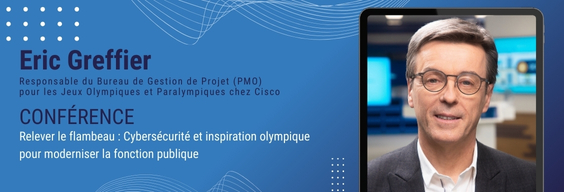
16H15 - SALLE E
The Olympic Games are not only a sporting achievement, but also a huge digital challenge. Behind the performances and the planetary party, thousands of computer attacks threaten the event every day. How do you protect an organization of this magnitude?
What lessons can we learn from this for our own environments? Through the concrete example of Paris 2024, this conference explores the behind-the-scenes of Olympic cybersecurity and the inspiration it can offer to all organisations.
Eric Greffier is currently Cisco Olympic & Paralympic PMO Lead / PMO for Project Management Office at Cisco Systems He has experience from his previous roles at Cisco Systems France.
Éric Greffier holds a Master of Science in Physics (1984 – 1987). He has a strong set of skills including leadership, product marketing, solution sales, channel management, strategic partnerships, among others.
WORKSHOPS - 50 minutes - Maximum 60 participants
10H00 - SALLE 1
Many organizations strive to deliver personalized customer service experiences powered by AI and self-service. However, creating, managing, and integrating multiple tools with specialized resources remains a challenge.
In this session, discover how the latest features of Amazon Connect enable organizations to create and manage conversational bots across multiple channels directly within Amazon Connect. With just a few clicks, you can leverage generative AI to assist in responding to users—without complex development costs. Explore the enhanced analytics capabilities to optimize these experiences, streamline processes, and help businesses deliver exceptional customer experiences.
Coming

10H00 - SALLE 2
The integration of artificial intelligence raises major challenges in governance, regulation, and data ethics. Discover how open-source software and Red Hat Private Cloud platforms (OpenShift + OpenStack Services) along with Red Hat OpenShift AI come together to turn these challenges into opportunities.
Red Hat’s cloud platform ensures complete and robust digital sovereignty, giving you full control over your data to comply with legal and regulatory frameworks. Building on this secure foundation, OpenShift AI then provides the tools to develop, deploy, and manage your AI models responsibly and in compliance. We will show you how to build an AI strategy that combines technological innovation with trust, turning compliance into a true competitive advantage.
The workshop includes a presentation and demonstrations.
BIO Martin Sauvé
Martin Sauvé is a seasoned platform architect at Red Hat, specializing in cloud solutions and artificial intelligence. With many years of experience as an industry speaker, Martin has developed unique expertise in designing robust and scalable architectures. He works closely with clients to help modernize their IT infrastructure and navigate the complex landscape of digital transformation, with a focus on private cloud and sovereign AI solutions.
BIO Sébastien-Charles Mussely
Sébastien-Charles Mussely is a digital transformation strategist with 26 years of experience as a consultant in the technology sector, with particular expertise in the public sector. He is recognized for his ability to simplify complex issues, helping executives, leaders, and architects turn government challenges into clear and actionable roadmaps. His strategic vision combines comprehensive expertise in architecture, security, solution operationalization, and finance. This approach enables him to lead complex projects end-to-end, design sophisticated financial structures, and analyze cost-benefit ratios, ensuring that ambitions translate into tangible results and that every decision is well-informed.

11H10 - SALLE 1
Digital sovereignty is an increasingly prominent and discussed strategic issue within both public and private organizations. Dependence on large foreign technology platforms raises questions about data protection and governance.
This conference will address the risks associated with this dependency, as well as potential solutions that enable institutions and businesses to strengthen their digital autonomy and the security of their information.
With over 40 years of experience, Robert specializes in SaaS, cloud computing, and data center management, combining technical expertise with strategic vision. His career, spanning both the public and private sectors in Canada and internationally, has enabled him to turn complex challenges into innovative solutions.
He is recognized for his ability to optimize IT infrastructures and ensure 24/7 operations, while guiding businesses through their digital transformation.

11H10 - SALLE 2
We will explore the major trends in artificial intelligence within the public sector, with particular attention to issues of sovereignty, data governance, and technology adoption. Through various themes derived from current market concerns, it examines organizational challenges, risks, and opportunities associated with AI deployment in government institutions, especially in the context of regulatory and geopolitical constraints.
The goal is to provide a nuanced perspective on strategic choices for hosting, experimenting with, and securing AI workloads, while presenting the technological framework that supports the success of public initiatives. The presentation is structured to allow a customized selection of topics such as digital sovereignty, the cost-effectiveness of GenAI projects, local use of LLMs, prototyping tools, and team organization and support models, enabling the discussion to be tailored to the audience’s priorities and needs.
Jonathan Tremblay has been working in the information technology sector for over twenty years, primarily in data center infrastructure and solutions. Currently Team Lead and Account Director, Data Centers at Dell Technologies, he supports Quebec’s public sector in adopting strategic technological solutions tailored to their sovereignty and performance challenges.
Holding a Bachelor’s degree in Computer Engineering from Université Laval, Jonathan has solid experience as a senior technical consultant, solutions architect, and project manager, with advisory and management assignments at organizations such as Dell EMC and Hitachi Vantara. His expertise enables him to provide a comprehensive and pragmatic vision for digital projects, particularly regarding AI integration and data security in critical public sector environments.
11H10 - SALLE 3
Principes de l’IA responsable;
Normes et standards à surveiller;
L’importance d’un cadre de gouvernance en IA;
Comment mettre en place un cadre de gouvernance IA de bout en bout;
Veille normative et réglementaire;
Différences entre les artefacts de gouvernance en IA;
Outils et mécanismes de mise en œuvre;
Communication et sensibilisation;
Résumé des bonnes pratiques
Expert en informatique avec deux baccalauréats et une maîtrise en sécurité informatique, a plus de 15 ans d’expérience en TI. Plus de 30 conférences externes. Développeur programmeur de formation, je me suis spécialisé dans la techno et infra cloud et l’IA. Aujourd’hui, je dirige un centre d’excellence d’IA chez COFOMO et opère comme ingénieur IA et conseiller stratégique IA/Cloud, et contribue aux normes ISO-IEC/42001 au sein du Conseil Canadien des Normes, membre contributeur d’IA responsable institution, fondateur de la communité d’IA à Québec où j’ai toujours combiné expertise technique et engagement. Entrepreneur et fondateur de l’entreprise de service de maintenance QSG.Inc.
15H00 - SALLE 1
L’innovation et l’IA ne peuvent produire de la valeur durable que si elles s’appuient sur des fondations solides : gouvernance, qualité, processus et un leadership qui favorisent une culture d’expérimentation et d’apprentissage. Ces piliers interagissent pour créer un écosystème performant qui doit également comporter un plan concret de développement de compétences clés des individus, des équipes et de l’organisation.
Cet atelier explore comment des fondations solides permettent de transformer l’information en décisions utiles et responsables et une prise de décision plus rapide. À l’ère de l’intelligence artificielle, les opportunités comme les risques comportent encore beaucoup d’inconnus, installer une gestion proactive rigoureuse et apprenante qui instaure la confiance permet d’avancer avec audace et de manière éthique et responsable, même dans l’incertitude et la complexité dans des environnements sensibles et clé comme la santé, l’éducation, les finances.
Passionné par la qualité et l’amélioration continue, Daniel Laforest accompagne depuis plus de 25 ans les organisations dans leur quête d’excellence. Ceinture noire Six Sigma, gestionnaire qualité certifié (CQM) et maître ITIL, il a aidé des centaines d’entreprises à structurer leurs processus et à optimiser leurs ressources.
Chez Edgenda, Daniel est un véritable agent de changement dans les projets de transformation qu’il entame. Son approche se fonde sur son leadership rassembleur et son franc-parler qui lui permettent de transformer les organisations. Il allie rigueur et pragmatisme pour générer des résultats en exploitant la puissance des données, l’innovation technologique et la force des équipes apprenantes.
Pilier du cadre méthodologique d’Edgenda, il inspire et guide ceux qui veulent convertir les défis complexes en opportunités de croissance réelle.

15H00 - SALLE 2
Unlocking effective collaboration begins with prioritizing human connection and using technology to help people collaborate more effectively. Logitech’s collaboration ecosystem offers the tools to create effective and equitable meeting spaces across any organization. With Logitech you can:
• Leverage AI features to embrace the meeting space as a place for community and connection.
• Equip workspaces with collaboration tools to make it easy for employees to gather from anywhere.
• Give the flexibility to choose a single or multiple collaboration platform across the organization.
Supporting customers across eastern Canada, design and deploy custom collaboration solutions to fit their needs and support their journey into new ways of working | – With a background as a solutions engineer, has been able to merge the solution story to find solutions to fit both IT and front office demands.
CAS CLIENTS - 30 minutes - Limite de 60 places
10H00 - SALLE 3
Découvrez comment Héma-Québec a accéléré sa transformation numérique et amélioré son efficacité opérationnelle grâce au Zscaler Zero Trust Exchange.
À mesure que l’organisation évoluait, les modèles traditionnels fondés sur le périmètre et les VPN ne répondaient plus aux besoins en matière de sécurité, de rapidité et d’agilité. En adoptant une stratégie Zero Trust propulsée par Zscaler Private Access (ZPA), Héma-Québec a retiré son VPN en moins d’un an — tout en améliorant l’expérience utilisateur, en simplifiant les opérations et en renforçant la sécurité à l’échelle de l’entreprise.
Joignez-vous à Laurent Chebbah, PMP, gestionnaire de projet et d’implantation Zscaler chez Héma-Québec, ainsi qu’à Sébastien Bourque, directeur du secteur public chez Zscaler, pour découvrir comment l’approche Zero Trust est devenue un véritable levier d’affaires.
Vous apprendrez :
– Comment les modèles d’accès modernes améliorent la sécurité et la productivité
– Les étapes pour simplifier l’infrastructure et accélérer la transformation
– Pourquoi Zero Trust procure des résultats mesurables que les outils traditionnels ne peuvent égaler
Suite à son parcours scolaire en informatique en Europe, Laurent a choisi le Québec comme maison. Ce fût une réussite, puisqu’aujourd’hui, il possède plus d’une décennie d’expérience en gestion de projets informatiques dans les plus grandes entreprises d’ici, notamment Desjardins, Hydro-Québec et Vidéotron. Son parcours lui a permis d’acquérir une compréhension technique en plus de gestion de projet, spécifiquement dans le contexte de nos organisations publiques. Aujourd’hui, chez Héma-Québec, il occupe le poste de directeur de livraison de programme en cybersécurité. Son expertise fût clef lors de la mise en place du projet Zscaler.
Avec plus de 25 ans d’expérience en technologies de l’information, Sébastien Bourque a accompagné les plus grandes organisations publiques et financières du pays dans leur transformation numérique. Suite à un parcours de plus d’une décennie auprès des manufacturiers de TI, il occupe aujourd’hui le poste de Directeur de comptes chez Zscaler, où il aide les entreprises à accélérer leur modernisation grâce au Zero Trust.
10H00 - SALLE 4
Les outils d’IA transforment déjà la façon dont les équipes développent du logiciel. On entend de plus en plus d’anecdotes de gains impressionnants grâce à des assistants comme GitHub, Copilot ou Cursor.
Dans cette conférence, découvrez comment évaluer de façon rigoureuse l’effet de l’IA sur votre cycle de développement. À travers le cas de Nexapp, nous vous montrerons une méthode pratique pour mesurer l’impact réel de l’IA sur la performance de vos équipes et vos processus de livraison.
Visionnaire orienté vers les résultats tangibles, Jonathan Lessard cumule plus de 11 ans d’expérience dans le domaine technologique. Président et cofondateur de Nexapp, il œuvre à garantir que chaque entreprise tire pleinement profit de la technologie, en maximisant et accélérant concrètement l’impact des investissements logiciels. Dans cette optique, il a aussi cofondé Axify, une plateforme SaaS qui offre une meilleure visibilité sur la performance des équipes de développement.
Sous son leadership, Axify s’est distinguée parmi les Best Workplaces for Innovators de Fast Company, soulignant l’engagement de Jonathan à allier performance d’équipe, innovation continue et impact mesurable. En 2025, il a été nommé PDG de l’année par l’Association québécoise des technologies (AQT), devenant le plus jeune lauréat de l’histoire du prix.

10H40 - SALLE 4
Discussion stratégique sur les défis et opportunités liés à la gouvernance de l’IA, la conformité réglementaire (Loi 25, AI Act), et l’intégration de pratiques responsables dans les projets numériques. La session explore comment transformer la gouvernance en levier d’innovation tout en anticipant les évolutions à venir.
Jean-François De Rico est associé chez KPMG Canada, basé à Québec. Il dirige les pratiques de conseil en gestion des risques technologiques et de protection de la vie privée pour la province. Avocat admis au Barreau du Québec en 2001, il est spécialisé en gouvernance de la cybersécurité, protection des renseignements personnels et gestion des risques liés à la transformation numérique. Avant de se joindre à KPMG, il était associé au cabinet Langlois Avocats, où il conseillait des clients en droit des technologies de l’information, protection des données et propriété intellectuelle.
11H20 - SALLE 4
Dans un monde où les attentes citoyennes évoluent rapidement, les organisations publiques doivent transformer la façon dont elles conçoivent, livrent et gèrent leurs services. Trop souvent, les processus restent fragmentés, appuyés sur des systèmes disparates qui créent des silos et ralentissent la capacité de réponse. Le Public Sector Digital Service (PSDS) a été conçu pour répondre à ce défi : offrir une plateforme unifiée qui simplifie la prestation de services numériques et améliore l’expérience des citoyens comme des employés.
Durant cette présentation, nous explorerons comment PSDS permet aux gouvernements et organismes publics de moderniser leurs opérations tout en gagnant en agilité. Nous verrons comment une approche axée sur les workflows numériques fluidifie la collaboration entre départements, améliore la transparence et réduit les délais de traitement. Nous illustrerons, à haut niveau, les résultats attendus dans diverses administrations au Canada : adoption accélérée des services en ligne, meilleure gestion des demandes citoyennes, et réduction mesurable des coûts opérationnels.
Au-delà de la technologie, PSDS incarne une nouvelle manière de concevoir le service public : centrée sur l’humain, évolutive et résiliente. Cette présentation mettra en lumière les bénéfices stratégiques d’une telle transformation pour les organisations publiques, tout en offrant une perspective sur l’avenir du numérique dans le secteur public.
Vous découvrirez pourquoi PSDS représente bien plus qu’une solution technologique : c’est un catalyseur de valeur et d’innovation pour le secteur public
Michaella Mutoni-Dorvlo est directrice de l’équipe de consultation en solutions ServiceNow pour le secteur public au Canada. Elle collabore avec les gouvernements fédéral, provinciaux et municipaux afin d’accélérer leur transformation numérique. Avec son équipe, elle aide les organisations publiques à moderniser leurs services, à optimiser leurs opérations et à offrir de meilleurs résultats aux citoyens. Forte de plus de dix ans d’expérience, Michaella allie une expertise approfondie en technologie à une passion pour l’innovation dans le service public.
Dr. Samir Sahli est un expert reconnu en données, intelligence artificielle et transformation numérique dans le secteur public. Avec plus de 15 ans d’expérience, il a accompagné des ministères, agences et municipalités à travers le Canada dans la modernisation de leurs services numériques. En tant que leader en Data & AI et aujourd’hui spécialiste des solutions ServiceNow CRM pour le secteur public, Dr. Sahli met son expertise au service de la simplification des processus, de l’amélioration de l’expérience citoyenne et de la création de valeur durable pour les organisations gouvernementales. est directrice de l’équipe de consultation en solutions ServiceNow pour le secteur public au Canada. Elle collabore avec les gouvernements fédéral, provinciaux et municipaux afin d’accélérer leur transformation numérique. Avec son équipe, elle aide les organisations publiques à moderniser leurs services, à optimiser leurs opérations et à offrir de meilleurs résultats aux citoyens. Forte de plus de dix ans d’expérience, Michaella allie une expertise approfondie en technologie à une passion pour l’innovation dans le service public.
Dr. Samir Sahli est un expert reconnu en données, intelligence artificielle et transformation numérique dans le secteur public. Avec plus de 15 ans d’expérience, il a accompagné des ministères, agences et municipalités à travers le Canada dans la modernisation de leurs services numériques. En tant que leader en Data & AI et aujourd’hui spécialiste des solutions ServiceNow CRM pour le secteur public, Dr. Sahli met son expertise au service de la simplification des processus, de l’amélioration de l’expérience citoyenne et de la création de valeur durable pour les organisations gouvernementales.

14H45 - SALLE 4
La Plateforme GenIA native de Google “Agents conversationnels de nouvelle génération de Google” utilise Gemini pour permettre aux entreprises de créer et déployer des agents conversationnels multimodaux ultra-sophistiqués, incluant des architectures multi-agents complexes.
Grâce à une expérience de construction intuitive, les concepteurs d’agents conversationnels peuvent simplement instruire le modèle sur le flux souhaité, tandis que des capacités d’Augmentation de l’IA et d’intégration d’outils et services externes (“Tools”) garantissent une performance optimale. Pour maximiser la souplesse, la plateforme supporte la réutilisation des flux déterministes existants d’agents conversationnels traditionnels de Google (Dialogflow CX) et l’utilisation de “Callbacks””.
La sécurité et la qualité sont intégrées dès le départ, avec des garde-fous personnalisables et des évaluations automatisées pour protéger vos agents et maximiser leur qualité. Ce cadre complet assure une expérience client prévisible et de haute qualité.
Coming

15H25 - SALLE 3
Et si l’intelligence artificielle n’était pas une révolution technologique, mais avant tout une révolution humaine ? Au fil de nos expérimentations avec M365 Copilot, nous avons découvert bien plus qu’un outil : un déclencheur de curiosité, d’audace et de collaboration.
Martin Beaumier détient une maîtrise en psychologie du développement organisationnel de l’Université de Sherbrooke (2000) et est membre de l’Ordre des psychologues du Québec. Il cumule plus de 20 ans d’expérience en planification, conception et mise en œuvre d’interventions en développement organisationnel et gestion du changement.
Actuellement Directeur expert conseil chez CGI, il siège au comité de direction du Centre d’excellence en gestion du changement pour l’unité d’affaires du Québec. Il est certifié Prosci et membre de l’Association of Change Management Professionals (ACMP). Auparavant, M. Beaumier a dirigé le Centre d’expertise en gestion du changement des ressources humaines corporatives de CGI, contribuant à l’élaboration de la stratégie et au développement des compétences en gestion du changement. https://www.linkedin.com/in/martin-beaumier/

15H25 - SALLE 4
Tout le monde parle d’intelligence artificielle agentique… mais comment l’utiliser concrètement dans nos organisations?
Lors de cette conférence de 30 minutes, Annie Veillet présentera un cas d’usage exclusif : la propre mise en œuvre de l’IA agentique chez PwC. À travers des exemples réels et tangibles, elle démontrera comment cette technologie transforme les façons de travailler, de recruter et de détecter les risques.
Découvrez trois plateformes développées par PwC
Agent OS : une plateforme d’agents intelligents qui assistent les équipes dans leurs tâches quotidiennes, améliorant la productivité et la qualité des livrables.
Plateforme RH agentique : utilisée pour automatiser et enrichir les processus de recrutement, en identifiant les meilleurs talents plus rapidement et avec plus de précision.
Plateforme de détection de fraude : intégrant des agents capables d’analyser des volumes massifs de données pour repérer des comportements suspects en temps réel.
Cette conférence s’adresse à tous ceux qui souhaitent passer de la curiosité à l’action, en découvrant comment l’IA agentique peut être appliquée dès aujourd’hui dans leur entreprise.
Associée, IA et données, PwC Canada
Annie Veillet est responsable des services d’IA et d’automatisation intelligente de PwC, et possède une vaste expérience dans la planification et la mise en œuvre de solutions complexes d’analytique avancée et d’automatisation. Elle a acquis une solide expérience en transformations analytiques (de l’identification des moteurs d’affaires à la mise en œuvre et à la mise à l’échelle des capacités), en automatisation des processus (avec composantes d’IA intégrées), en segmentation de la clientèle selon les traits de comportement, et en gestion des données.
Annie a codirigé la création de la trousse mondiale IA responsable de PwC, qui a récemment remporté quatre prix (dont celui de la réalisation exceptionnelle, toutes catégories confondues) au sommet CogX.
Annie a été nommée par RE.WORK au palmarès des 30 femmes les plus influentes dans le domaine de l’IA à Montréal. Ses activités de mentorat et de promotion de l’utilisation de l’IA pour faire du bien (AI for Good) lui ont valu une nomination au palmarès mondial des femmes les plus brillantes du domaine de l’éthique de l’IA, mais en plus, elles ont permis à son équipe d’obtenir une plus grande reconnaissance publique.
Annie a acquis une vaste expérience auprès de divers clients cotés en bourse au Canada, aux États-Unis et en Australie. Ces dernières années, elle a travaillé à apporter de la valeur aux équipes Capital-investissement et Gestion d’actifs.
PODCAST
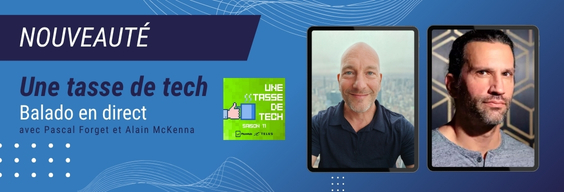
This year, we welcome Pascal Forget and Alain McKenna from the podcast Une tasse de tech.
Tout au long de la journée, ils animeront, en direct, notre balado.
MAJOR THEMES 2025
1-Digital governance and responsible AI
Explore the ethical, regulatory and organizational issues related to data management and the integration of artificial intelligence in a responsible and compliant framework.
2-Strategic data and sustainable performance
Enhance data in key sectors (health, education, finance, etc.) while optimizing resources through a sober, agile and continuous improvement-oriented approach.
3-Human skills and leadership of the future
Adapting to the transformation of roles, structures, and skills in a digital world, while considering human impact: cognition, mental health, and emotional intelligence.
4-Quantum technologies: power and vigilance
Demystify quantum, understand its concrete applications and anticipate its implications in terms of cybersecurity, ethics and society.
OUR 2025 PARTNERS
AMBASSADOR











SIGNATURE





PRESTIGE















PARTICIPATORY











RELIEF



MEDIA


Would your organization like to partner with our next edition of the JIQ?
Raise your profile within the industry by becoming a JIQ partner! There are many opportunities for you to promote your company, position your expertise and strengthen your brand.
Interested? Contact us: jiq@actionti.com






ORGANIZING COMMITTEE

Isabelle Tremblay
Enterprise Account Manager
President of the Organizing Committee

Dominic Dumais
Delivery Practice Manager
Amazon Web Services (AWS)
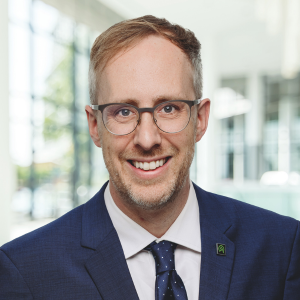
Frédéric Martel
Vice-President, Information Resources,
SEPAQ

Jessica Sinclair

Jérémie Guay
Assistant Director, Centre of Excellence in Business Analysis,
Beneva
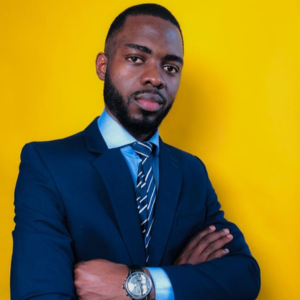
Frank Zang
Business Analyst,
Cofomo

Anne-Marie Goyette
Head of the Project Office and Business Intelligence
Laval University

Christine Canuel
Technical Advisor
Bell
CONTACT US
For all questions relating to the ticket office, contact info@actionti.com
For all other questions regarding the JIQ, contact jiq@actionti.com
Organized by